English
 中文简体
中文简体Content
- 1 First, Separate Fiber, Yarn, and Fabric Construction
- 2 Knit vs Woven: The Core Construction Difference
- 3 Common Types of 100% Cotton Knit Fabric
- 4 Why Cotton Is One of the Most Knitted Fibers
- 5 How to Identify a 100% Cotton Knit Fabric
- 6 Performance Benefits and Limitations of 100% Cotton Knit
- 7 100% Cotton Knit vs Common Cotton Blends
- 8 How to Choose and Specify 100% Cotton Knit Fabric
- 9 Frequently Asked Questions
- 10 Final Thoughts
Yes, 100% cotton can be a knit fabric. The word "knit" is a description of fabric construction, not a description of fiber content. Cotton is a natural fiber, and it can be spun into yarn. That yarn can be knitted into loops, or it can be woven into a cross-hatch grid. When cotton yarn is knitted, the result is a 100% cotton knit fabric. When cotton yarn is woven, the result is a 100% cotton woven fabric. So the answer to "Is 100% cotton a knit fabric?" is: it can be, but it is not automatically knit or woven by fiber content alone.
This is more than a trivia question. For anyone who buys, sews, or specifies cotton fabrics, the distinction determines stretch, breathability, drape, shrinkage, and durability. A cotton T-shirt is usually a knit. A cotton dress shirt is usually woven. Both can be 100% cotton, but they behave completely differently. This guide explains what those terms mean, what kinds of 100% cotton knit fabrics exist, how to identify them, and what to consider before buying.
First, Separate Fiber, Yarn, and Fabric Construction
Most cotton confusion begins when the word "cotton" is used for three different things: cotton fiber, cotton yarn, and cotton fabric. These are different production stages, and each one affects the final fabric.
Cotton fiber grows in a boll around a seed. The length, fineness, and strength of those fibers define quality. Long-staple cotton is generally softer and stronger, but all cotton fiber starts as a raw material. It has no orientation and no visible structure until it is spun.
Spinning twists cotton fibers into yarn. Yarn can be thick or thin, smooth or slubby. In textile terms, the thickness of cotton yarn is often expressed in English count, such as 21s, 32s, 40s, or 50s. A higher count means a finer yarn. The same cotton fiber can become a coarse yarn for sweatshirt fleece or a fine yarn for lightweight jersey.
Yarn then goes through a fabric-forming process. It can be interlaced, which is weaving; looped, which is knitting; or bonded, which creates nonwoven fabric. The fabric-forming process defines the final structure. Therefore, "100% cotton" tells you only the raw material, not the construction.
In practice, labels use terms like "100% cotton knit jersey" or "100% cotton woven poplin." The words "knit" and "woven" are what tell you about the structure. Without those words, you cannot know whether a cotton fabric will stretch, curl, drape, or feel smooth.
Knit vs Woven: The Core Construction Difference
A knit fabric is made from yarn that is formed into loops. Each loop is pulled through a previous loop, producing a chain-like structure. If a loop is snagged, the fabric can unravel easily. Knits are naturally elastic because the loops can open and close with movement.
A woven fabric is made on a loom with warp yarns running lengthwise and weft yarns running crosswise. The yarns cross over and under each other. Woven fabric generally does not stretch along the grain, although it can stretch slightly on the bias. If a yarn breaks in a woven fabric, the structure may distort or form a hole, but it does not unravel in the same way a knit does.
| Property | Knit Cotton | Woven Cotton |
|---|---|---|
| Yarn arrangement | Loops interlocked together | Warp and weft yarns interlaced at right angles |
| Natural stretch | High, especially widthwise | Low, except on the bias |
| Edge behavior | Jersey edges curl; rib edges lie flat | Edges fray when cut |
| Surface texture | Visible loops or ribs | Flat, smooth grid |
| Typical garment uses | T-shirts, underwear, sweaters, loungewear | Shirts, trousers, denim, bedding |
Cotton is especially well suited to knitting because cotton fibers are absorbent and accept natural stretch well. This is why most T-shirts, undergarments, baby clothes, and loungewear are made from cotton knit. For a more detailed introduction to knit terms, you can read our complete guide to jersey cotton and knit fabric.
Common Types of 100% Cotton Knit Fabric
Not all cotton knits are the same. The construction method, machine gauge, yarn count, and finishing process create different fabrics. Here are the most common categories used in garment production.
Single Jersey
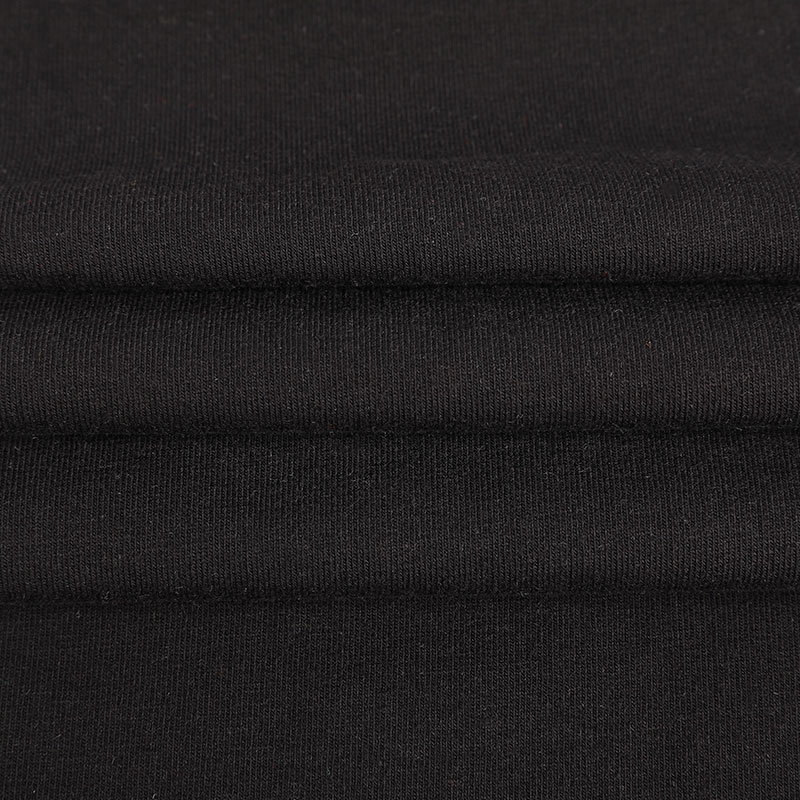
Single jersey is the most basic and most common cotton knit. It has a smooth V-shaped face and a back with horizontal floats. The edges curl noticeably. It has both vertical and horizontal stretch, with more stretch in the width. Standard T-shirts, nightdresses, and lightweight dresses are usually single jersey. Weight typically ranges from 120 to 180 gsm in 100% cotton.
 21s JC BCI Imported Yarn Single Jersey FabricThis 100% cotton single jersey uses BCI-certified imported yarn for softness and breathability. Positioned after basic jersey details, it suits daily wear, sportswear, and T-shirts while meeting sustainability standards.View Product →
Rib Knit
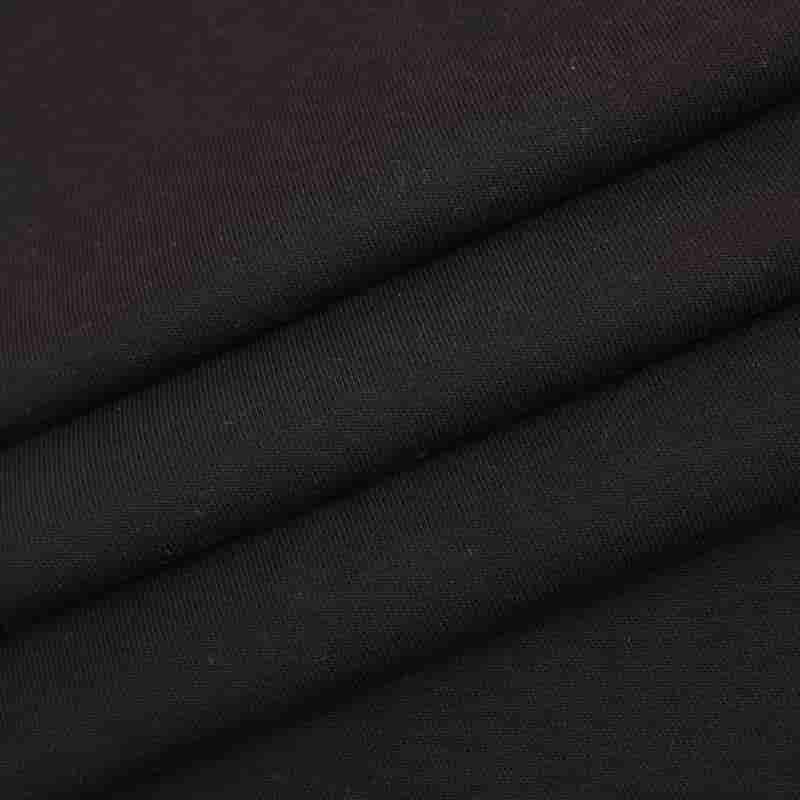
Rib knit has vertical ribs on both the front and the back. Because the face and back are formed by alternating knit and purl stitches, rib pulls the fabric into a straight, narrow structure. This gives it excellent horizontal stretch and recovery. 1x1 and 2x2 ribs are common. Ribbing is used for collars, cuffs, waistbands, and close-fitting tops. In heavier weights, rib makes comfortable turtlenecks, leggings, and loungewear.
 28s JC 1x1 Rib Knit FabricA 1x1 rib knit with uniform narrow ribs and good elasticity, ideal for underwear, inner wear, and T-shirt collars. Shown after rib properties, it highlights horizontal stretch and recovery for close-fitting garments.View Product →
Interlock
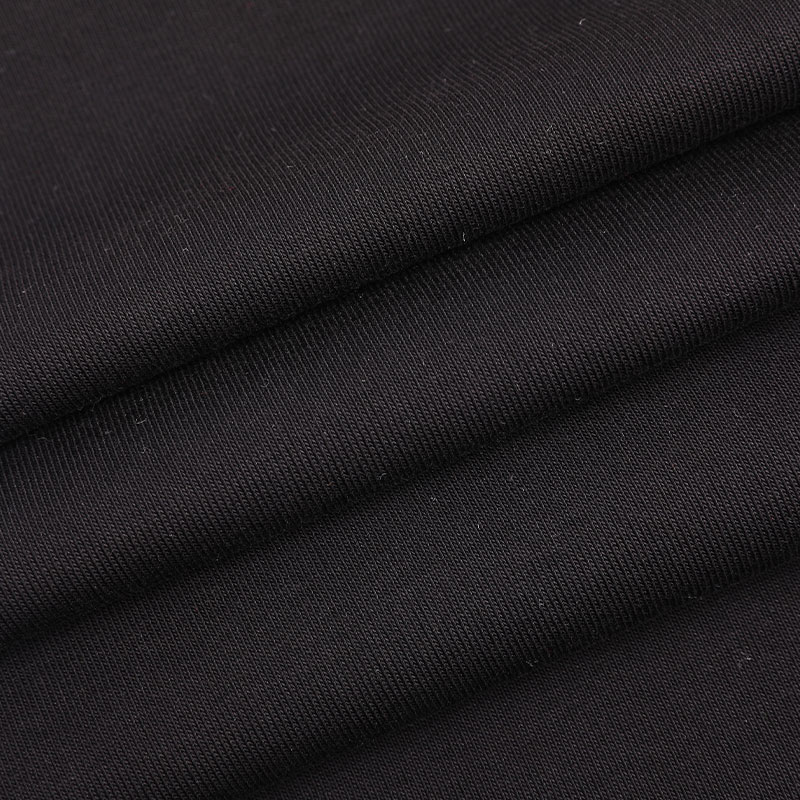
Interlock is a double-knit cotton fabric made by interlocking two single jersey layers. It has a smooth face and a smooth back, with no curling edges. It is heavier and more stable than single jersey, with a flat and compact surface. Interlock is often used for baby clothes, seamless-look garments, and premium sleepwear. It also holds printed designs well.
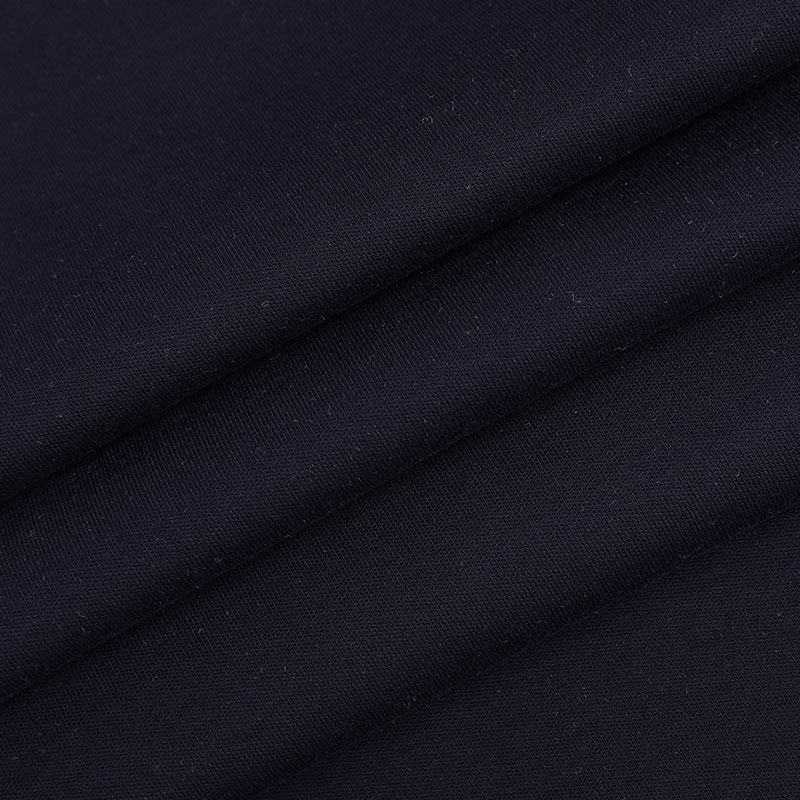 40s JC BCI Imported Yarn Mercerized Interlock FabricThis interlock fabric combines fine combed cotton and mercerized yarn for a smooth, stable surface. Building on interlock benefits, it suits babywear, premium sleepwear, and printed garments without edge curling.View Product →
Pique
Pique knit has a textured geometric surface, often described as a honeycomb or waffle pattern. It is made with tuck loops and is most famous for polo and golf shirts. Pique is more breathable than a dense jersey because the texture creates small air channels. It is also less clingy, which makes it a good choice for casual button-front knit shirts.
Terry and Fleece
Terry and fleece are looped cotton knits with a soft, absorbent surface on the inside or outside. Traditional three-thread fleece has a smooth face and a brushed back, ideal for sweatshirts, hoodies, and casual jackets. Loop terry often appears in beachwear, towels, and baby accessories. These fabrics are heavier, usually from 200 to 320 gsm.
Air Layer and Double Knit
Air layer cotton fabrics have two separate faces connected by interlocking threads, creating a raised central space. This structure traps air and adds insulation. Air layer knits are used for outerwear, cardigans, and winter dresses. They are stable, shape-retentive, and have an almost woven hand feel.
Each of these structures changes how 100% cotton behaves. A single jersey is lightweight and drapey. A rib is stretchy and springy. An interlock is smooth and compact. A pique is textured and breathable. A terry is warm and absorbent.
Why Cotton Is One of the Most Knitted Fibers
Cotton has been knitted for centuries, long before modern circular machines. The reason is simple: cotton yarns are strong enough to withstand the bending and pulling of loop formation, and the fibers have a natural surface friction that helps loops stay locked together.
Cotton is also comfortable in changing temperatures. It absorbs moisture from the skin and releases it into the air. In warm weather, a cotton knit T-shirt feels cool because the airflow through the loops helps evaporation. In cooler weather, a heavier cotton knit like fleece traps warm air between the yarns and the body.
From a production standpoint, cotton yarn knits efficiently on circular weft knitting machines. These machines can produce wide rolls of fabric continuously, which makes cotton jersey and related fabrics affordable for mass-produced clothing. The same cotton fiber, if woven on a loom, requires more preparation and produces a more rigid cloth.
This versatility is why "cotton knit" and "100% cotton" appear together so often in clothing and textile catalogs. The fiber and the structure are not competitors; they are two separate decisions made during manufacturing.
How to Identify a 100% Cotton Knit Fabric
If you are looking at fabric in a store or examining a garment, you do not need a microscope. A few simple clues will tell you whether a cotton fabric is knit.
- Look at the surface: Knit fabric shows small loops or vertical wales. Woven fabric shows a flat, intersecting grid.
- Stretch it widthwise: Knit fabric stretches easily and tends to spring back. Woven cotton resists stretch, except at a 45-degree bias.
- Observe the cut edge: A single jersey edge curls to the back. A woven cotton edge frays into separate yarns.
- Snag the surface with a pin or fingernail: A knit will pull up a small loop. A woven may break a yarn or leave a permanent line.
- Check the garment style: T-shirts, underwear, and sweatshirts are normally knits. Button-front dress shirts and denim jeans are normally wovens.
| Clue | Knit | Woven |
|---|---|---|
| Surface | Loops or vertical ribs | Flat grid of warp and weft |
| Stretch | Stretches in width and often in length | No stretch on the grain |
| Edge | Curls, especially single jersey | Frays |
| Recovery | Moderate to good, depends on structure | Poor, does not stretch back |
| Example garments | T-shirt, hoodie, polo, underwear | Dress shirt, denim, canvas trousers |
Always read the label if one is available. A label that says "100% cotton jersey" or "100% cotton rib" tells you the structure. If the label only says "100% cotton," ask for the structure or look closely at the yarn texture before you make a buying decision.
Performance Benefits and Limitations of 100% Cotton Knit
100% cotton knit has natural breathability and moisture absorbency. Cotton fibers can absorb water up to 24% of their own weight while still feeling dry to the touch. That is why cotton knit T-shirts feel comfortable in warm weather and why cotton knit baby clothes are gentle against sensitive skin.
Cotton knit is also soft because the loop structure creates many small air pockets. As the fabric washes, the cotton fibers relax and the fabric often becomes even softer. This is a clear advantage over many synthetic knits, which can develop a slippery or worn surface over time.
At the same time, 100% cotton knit has limits. It tends to shrink in the first few washes, it wrinkles, and it dries more slowly than polyester or nylon. It can also lose shape in areas that are stretched repeatedly, such as elbows, necklines, and waistbands.
Textile mills address some of these issues through yarn and finishing choices. Combed cotton reduces pilling. Compact spinning makes the yarn smoother and stronger. Mercerization improves luster and dimensional stability. Pre-shrinking can bring shrinkage down to around 3 to 5%.
Stretch values vary with yarn count, machine tension, and finishing. The chart is not a specification; it is a practical guide. A fabric with many loops per inch will behave differently from an open-loop fabric, and a brushed fleece will stretch less than a lightweight jersey.
100% Cotton Knit vs Common Cotton Blends
Many buyers ask whether 100% cotton knit is better than cotton/spandex or cotton/polyester. There is no single best answer. 100% cotton gives you natural softness and absorbency, but it has less recovery and can shrink more than a blend. Adding spandex improves stretch and shape retention. Adding polyester improves wicking, shrink resistance, and durability.
| Property | 100% Cotton | Cotton + Spandex | Cotton + Polyester |
|---|---|---|---|
| Softness | Very soft, natural | Soft with mechanical stretch | Slightly firmer |
| Stretch and recovery | Natural stretch, low recovery | High stretch, excellent recovery | Low stretch, good shape retention |
| Shrinkage resistance | Moderate, depends on finishing | Better with spandex control | Good |
| Moisture absorbency | High | High | Lower than pure cotton |
| Drying speed | Slow | Slow to moderate | Fast |
| Best use | T-shirts, underwear, sleepwear | Activewear, fitted tops, leggings | Workwear, sweatshirts, performance wear |
If you choose a blend, make sure the label clearly states fiber percentages. A fabric with 95% cotton and 5% spandex is still mostly natural, but the stretch and recovery will be very different from a 100% cotton jersey.
How to Choose and Specify 100% Cotton Knit Fabric
When buying 100% cotton knit fabric for production, the first decision is the intended garment. A lightweight single jersey works well for T-shirts and casual dresses. A rib knit is suited for close-fitting basics, collars, and cuffs. An interlock is good for sleepwear and baby clothes. A pique is a classic choice for polos, and a terry or fleece works for sweatshirts and hoodies.
Next, specify yarn count and GSM. For a classic summer T-shirt, choose 40s or 50s combed cotton around 140 to 150 GSM. For a thicker winter sweatshirt, choose 21s cotton fleece around 240 to 260 GSM. For underwear, a 32s compact cotton interlock with a clean hand feel is a common preference.
| Fabric Type | Yarn Count | Typical GSM | Common End Use |
|---|---|---|---|
| Single jersey | 40s or 50s combed | 130-160 | T-shirts, nightdresses |
| Rib knit | 28s or 32s | 180-240 | Collars, cuffs, turtlenecks |
| Interlock | 32s or 40s | 160-220 | Baby clothes, sleepwear, undergarments |
| Pique | 32s or 40s | 180-240 | Polo shirts, golf shirts |
| Terry / fleece | 21s or 32s face yarn | 240-320 | Hoodies, sweatshirts, joggers |
Also ask about shrinkage, pilling, and color fastness. Perform a wash test on a sample before you commit to a large order. In our experience at Tongxiang Ruicheng Knitting, a simple home wash test eliminates the most common quality surprises.
If you are sourcing sustainable fabric, consider BCI cotton or organic cotton. Many of the cotton fabrics we develop use BCI imported yarns, which support better farming practices and provide a clear supply chain. To see a curated selection of cotton options, you can visit our cotton knit fabric collection.
Frequently Asked Questions
Is 100% cotton knit fabric stretchy?
Yes. The loop structure gives it natural stretch, even without spandex. A single jersey will stretch more in the width than in the length. Rib knit stretches even more horizontally. However, the recovery is limited compared with spandex blends. If you want a garment to return strongly to its original shape, a cotton/spandex knit may be more suitable.
Does 100% cotton knit shrink?
It can. Cotton yarns absorb water and swell during washing; agitation can tighten the loops. The usual shrinkage for a correctly pre-shrunk cotton knit is 3 to 5%. With proper finishing and cool-water washing, shrinkage can be lower. Always check the care label and ask the supplier for wash-test data.
Is cotton jersey the same as cotton knit?
Cotton jersey is a type of cotton knit. It is a single jersey construction with a flat V-shaped face and a ribbed-looking back. Not every cotton knit is jersey; rib, interlock, pique, and terry are all cotton knits with different structures. When people say "cotton knit" in a general way, they often mean jersey, but the terms are not interchangeable.
Is 100% cotton woven fabric also possible?
Yes. If 100% cotton yarn is woven on a loom, the result is a 100% cotton woven fabric. Examples include cotton poplin, cotton twill, cotton denim, cotton sateen, and cotton canvas. The difference is purely construction: knitted cotton has loops, while woven cotton has interlacing yarns.
Can I use 100% cotton knit fabric for a shirt?
Yes, especially for a polo shirt, a relaxed shirt, or a T-shirt. A woven cotton shirt will give a crisp, formal silhouette; a knit cotton shirt will give a softer, more casual fit. Pique knit is a common choice for a collared short-sleeve shirt because it is structured enough to hold a collar but still stretchy and breathable.
How should I care for 100% cotton knit fabric?
Wash in cool water, avoid high dryer heat, and dry flat if possible. Because cotton knit loops can be distorted by force, do not wring or tumble dry at high temperature. A mild iron on the reverse side is safer than ironing the face. Proper care extends the shape and softness of the garment.
Final Thoughts
Is 100% cotton a knit fabric? The precise answer is that 100% cotton is a fiber content. It becomes a knit fabric when cotton yarn is formed into loops. Whether you are buying a T-shirt or specifying fabric for a new line, knowing the fiber, the yarn, and the construction will help you predict how the fabric behaves.
At Tongxiang Ruicheng Knitting, we have spent years producing cotton jersey, rib, interlock, pique, and terry fabrics for garment makers around the world. We develop fabrics from yarn to finished cloth, and we know that construction is as important as fiber. If you need a cotton knit with a specific weight, hand feel, or performance level, start with a clear specification and request a sample.
In the end, the best cotton fabric is not simply 100% cotton. It is the right cotton structure for your product.