

 English
 中文简体
中文简体 +86-13967368270
Contact Us for more details
Want to know more? Message Us Right Now!
A sourcer opens a courier parcel and pulls out a swatch labeled cotton knit. The tech pack says 100% cotton. The lab report on the next page reads 94.6% cotton and 5.4% elastane. The color is right, the hand feel is right, and the order is still on hold because three words and one number do not agree with each other. ...
Cotton knit is a soft, stretchy fabric made by looping cotton yarns together rather than weaving them over and under. That single structural fact explains most of what buyers, designers, and product developers notice in the material: it stretches, it breathes, it drapes, and it can be engineered into very different we...
A Portuguese buyer sends a 40-metre sample request with one line attached: what is jersey knit cotton fabric, and can you knit it at 180 gsm? That single question usually hides three more. How much will it shrink after three home washes? How much will it stretch across the width? Will the tenth container match the lab...
Want to know more? Message Us Right Now!
The elasticity of Bamboo Spandex Jersey Knit Fabric exhibits a distinct "directional difference." This is determined by the structural characteristics of the single jersey knit—specifically the way the loops are arranged—rather than solely by the fiber material itself. In a knit structure, yarns are arranged in loops; horizontally (along the course), these loops can expand freely, resulting in high elasticity. Vertically (along the wale), the structure consists of interlinked loops, limiting the space for extension and resulting in lower elasticity. This structural difference creates the fabric's characteristic profile: strong horizontal elasticity and weaker vertical elasticity.
In industrial production, adding spandex significantly boosts horizontal elasticity and recovery, yet it does not eliminate the directional difference. Consequently, the elasticity typically falls within the following ranges:
Regarding horizontal elasticity (Width/Weft direction), standard bamboo-spandex jersey (with a spandex content of approximately 3%–5%) usually has an elongation rate of 40%–80%, depending on the fabric weight (GSM), gauge, and the method of spandex wrapping. If the spandex content is increased to 6%–10% and double-covered spandex yarn is used, horizontal elasticity can rise to 80%–120%, or even higher for lightweight fabrics (under 160 GSM). However, it is important to note that higher elasticity does not necessarily equate to better quality; high elasticity often comes at the cost of structural stability and the fabric's recovery lifespan.
Regarding vertical elasticity (Length/Warp direction), the improvement gained by adding spandex is limited due to the constraints of the interlinked loop structure. Vertical elasticity generally remains between 10% and 30%; while versions with higher spandex content may show slightly higher figures, they rarely exceed 40%. This is because vertical stretching relies primarily on loop "slippage" rather than "expansion," resulting in greater structural restriction.
Based on industry experience, the elasticity ratio for this type of fabric can be simplified as follows:
> Horizontal Elasticity ≈ 2–4 times Vertical Elasticity
Additionally, fabric weight (GSM) plays a significant role in determining elasticity. Fabrics with lower basis weights have looser structures and allow more room for stitch loops to move, resulting in higher elasticity but lower stability; conversely, fabrics with higher basis weights have tighter structures, offering greater stability at the cost of some elasticity. Additionally, factors such as yarn twist, the uniformity of spandex wrapping, and post-finishing heat-setting processes significantly influence the final elastic performance.
"Bagging" (localized bulging or sagging/deformation) is a common issue with elastic knit fabrics subjected to prolonged stress, particularly in high-stress areas subject to repeated bending, such as the knees, elbows, and seat. For Bamboo Spandex Jersey Knit Fabric, this phenomenon arises from a combination of factors, including spandex fatigue, the relaxation of the bamboo fiber structure, and the permanent deformation of the jersey knit loops.
From a material perspective, bamboo viscose fibers inherently possess low elasticity; the fabric relies primarily on its knit structure—rather than the fiber's own resilience—to provide stretch. When the fabric undergoes repeated stretching or compression, the loop structure undergoes gradual "plastic deformation," meaning some of the distortion cannot be fully recovered. Furthermore, while spandex provides elasticity, it is susceptible to "elastic fatigue" under the influence of prolonged mechanical stress, thermal stress, and repeated washing cycles, resulting in reduced recovery power.
In actual wear, the formation of bagging typically progresses through three stages: the first stage is short-term deformation, where the fabric quickly recovers after stress is removed; the second stage is mid-term relaxation, where the rate of localized recovery slows down after repeated use; and the third stage is permanent deformation, where a visible bulge forms in a specific area and fails to recover. The knees and seat are the most vulnerable areas, as they are subjected to both stretching and continuous pressure (such as compression while sitting).
For Bamboo Spandex Jersey Knit Fabric, the risk of bagging depends largely on three key parameters: spandex content, spandex quality (standard vs. high-recovery spandex), and the heat-setting finishing process. If the spandex content is below 5%, structural support is insufficient, making visible bagging likely after prolonged wear; conversely, a spandex content of 6%–10%, combined with a heat-setting process, can significantly improve dimensional stability and reduce the risk of deformation.
Additionally, yarn structure plays a crucial role. Using high-twist yarns or covered spandex yarns can enhance structural stability and minimize loop slippage, thereby reducing the likelihood of bagging. Conversely, low-twist or loose structures are more prone to deformation.
Overall assessment:
Therefore, this fabric is not inherently resistant to bagging; rather, it is an elastic fabric system that relies heavily on engineering controls.
The dyeing and finishing of bamboo spandex jersey knit fabric involves a process of moderately high complexity. The core challenge stems from the structural differences between the two components: natural fiber and elastic fiber. Bamboo fiber (typically bamboo viscose) is a cellulosic material with a high affinity for reactive dyes; it absorbs dye rapidly and strongly. However, this rapid initial uptake can lead to localized "over-absorption," resulting in uneven color distribution, variations in shade depth, or a mottled/cloudy appearance.
Conversely, spandex is a hydrophobic polymer with a dense molecular structure; it barely reacts with conventional dyes, often appearing as "inert" (undyed) fibers in the finished product. When stretched, spandex may exhibit a slight "white core effect," causing areas under high tension to appear visually paler. This disparity between the high dye affinity of bamboo fiber and the low affinity of spandex is a primary cause of color shading (or barré effects).
Furthermore, the jersey knit structure (single-knit weft construction) inherently involves tension variations during circular knitting. Slight differences in yarn feed tension, stitch density, or knitting speed—whether between batches or different machines—can further exacerbate uneven dyeing. Consequently, this type of fabric is classified in the industry as a system that is highly sensitive to both structural and material factors during dyeing.
Against this technical backdrop, the role of Tongxiang Ruicheng Knitting Co., Ltd. in producing such fabrics lies in the systematic synergy between stable upstream knitting and precise downstream dyeing and finishing control.
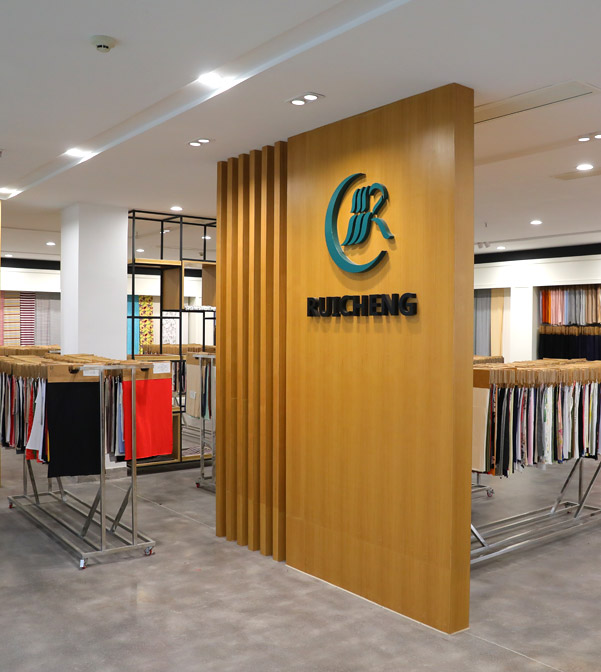
The company is located in the industrial zone of Chongfu Town, Tongxiang City, Zhejiang Province. Situated within the core textile industrial belt of the Yangtze River Delta, the company benefits from a comprehensive textile supply chain and an efficient logistics network (located 145 km from Shanghai, 45 km from Hangzhou, and 110 km from Suzhou). This strategic location enables rapid response capabilities regarding yarn supply, the procurement of dyes and chemicals, and order fulfillment. This locational advantage is particularly crucial for bamboo-spandex knitted products, which require frequent adjustments to formulations and color standards due to the multiple rounds of sampling and color correction typically involved.
In terms of production capacity, Tongxiang Ruicheng Knitting Co., Ltd. operates over 50 large-diameter circular knitting machines and maintains a comprehensive knitted fabric production system. Its product range encompasses various structures, including single jersey, spandex jersey, interlock, rib, mesh, and air layer fabrics. This enables robust structural control during the knitting phase, allowing the company to mitigate dyeing risks through measures such as:
These measures significantly reduce the likelihood of "structural shading" (uneven dyeing caused by fabric structure) at the initial knitting stage.
In terms of functional positioning, Bamboo Spandex Jersey Knit Fabric is better classified as a "comfortable stretch knit" rather than a "structural compression sports fabric." To determine its suitability for medium-compression sportswear, one must compare it against the core requirements of compression garments.
Medium-compression sportswear typically requires the following characteristics: high and stable transverse elasticity (usually >100%), excellent recovery rates (>90%), the ability to deliver sustained compression, and long-term resistance to material fatigue. Such garments usually employ high-density knit structures—such as interlock, tricot, or power stretch—combined with a high percentage of spandex (typically 8%–20%) to provide consistent compression.
In contrast, while Bamboo Spandex Jersey Knit Fabric offers good transverse elasticity and comfort, its single-jersey structure provides relatively weak structural support. Even with the addition of spandex, the primary function is to enhance stretch and ensure a comfortable, body-hugging fit rather than to provide sustained compression. Consequently, during prolonged wear or high-intensity exercise, its compression performance tends to degrade, leading to issues such as uneven pressure distribution or a loss of support.
Furthermore, bamboo fiber is inherently highly absorbent and soft to the touch. While these qualities enhance wearing comfort, in the realm of compression sportswear, this "softness" actually compromises structural stability, making the fabric better suited for "comfortable, close-fitting wear" than for "functional support."
Therefore, this fabric is better suited for the following applications:

 CONTACT US